
Dallisgrass Control in Turfgrass: Why Fall Is the Best Time to Take Action
Dallisgrass is one of the most difficult perennial grassy weeds to control in warm-season turf. Its aggressive growth, extensive rhizome system, and prolific seed production allow infestations to spread and persist year after year. While many turf managers attempt to manage dallisgrass during peak summer growth, research indicates that late summer through early fall is one of the most effective times to begin a control program.
 |
 |
How to Identify Dallisgrass
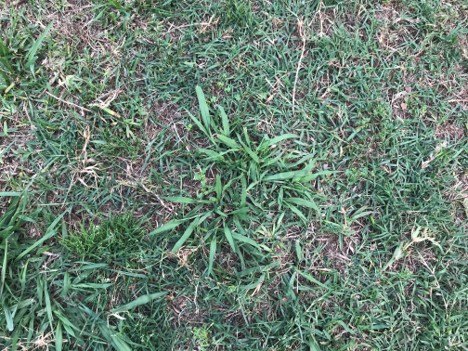
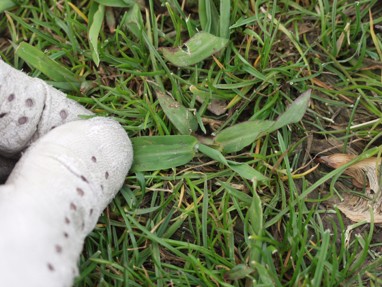
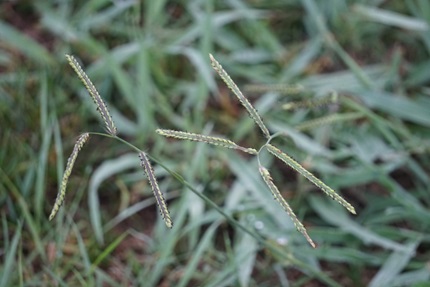
Accurate weed identification is critical for successful control. Dallisgrass grows in coarse, upright clumps that often appear lighter green than surrounding turf. It is commonly found in bermudagrass and zoysiagrass fairways, roughs, sports fields, and managed landscapes. One of its most recognizable features is its seedhead, which consists of several finger-like spikes that emerge from a central stem. Unlike annual grassy weeds such as crabgrass, dallisgrass is a perennial weed, meaning established plants can survive from year to year through an extensive underground rhizome system.
When is the best time to control dallisgrass?
Late August through early fall, when plants are actively growing and can effectively absorb herbicide applications.
Why is dallisgrass so difficult to control?
Dallisgrass spreads through both rhizomes and seed production, allowing it to recover and reinfest turf areas if not properly managed.
What is the best selective herbicide labeled for dallisgrass control in bermudagrass and zoysiagrass?
Tribute® Total herbicide. Not only does Tribute Total control dallisgrass, it’s formulated to provide broad-spectrum, postemergence weed control of sedges, kyllingas and 55 broadleaf weeds in Bermudagrass and zoysiagrass.
Why Tribute Total Is Different
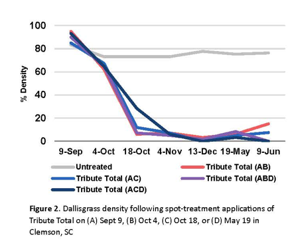
Tribute Total herbicide contains three active ingredients: thiencarbazone-methyl, foramsulfuron, and halosulfuron-methyl. This combination provides broad-spectrum postemergence control of grasses, sedges and broadleaf weeds while delivering something unique: it is the only selective herbicide labeled for dallisgrass control in bermudagrass and zoysiagrass.
Many products can suppress dallisgrass, but Tribute Total can control it while preserving desirable turf. Research has shown that programs initiated in late summer and early fall can significantly reduce dallisgrass populations, especially when sequential spot treatments are utilized.
How many applications are typically needed?
At least two spot-treatment applications, with a follow-up application generally made 28 to 42 days after the initial treatment.
What are the best practices for successful dallisgrass control
- Begin applications when dallisgrass is actively growing.
- Start spot-treatment programs in late August or early September when possible.
- Make a second application 28 to 42 days after the first treatment.
- Monitor treated areas the following spring and retreat any surviving plants as needed.
- Avoid applications to stressed turf or when rainfall is expected shortly after treatment.
Quick Reference: Dallisgrass Control
Weed: Dallisgrass (Paspalum dilatatum)
Weed Type: Perennial grassy weed
Key Identification Features: Coarse clumps, rapid growth, finger-like seedheads, extensive rhizomes
Best Treatment Timing: Late summer through early fall
Recommended Solution: Tribute Total herbicide
Active Ingredients: Thiencarbazone-methyl + Foramsulfuron + Halosulfuron-methyl
Recommended Strategy: Sequential spot treatments for maximum control
Successful dallisgrass management starts with proper identification and timely treatment. For detailed questions about dallisgrass control, application timing, or turf-specific recommendations, contact your local Envu Green Solutions Team member or Envu representative for expert guidance.